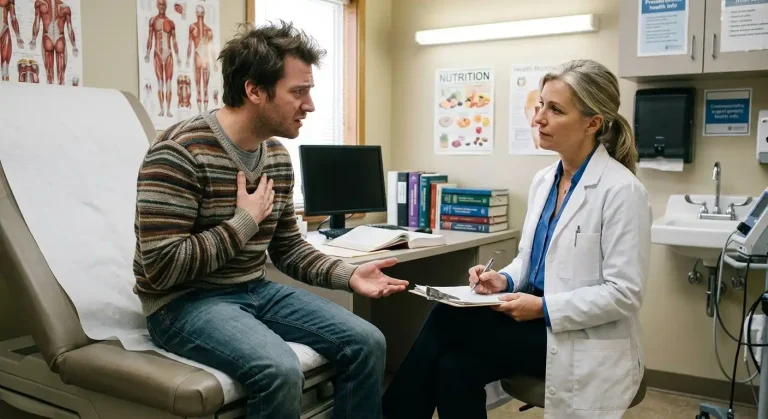
Picture a Tuesday afternoon. It’s 2:30pm, and you’re staring at your computer screen, reading the same paragraph for the fourth time. Your coffee is cold. Your patience ran out an hour ago. You snapped at a coworker this morning over something small, and you’re still annoyed at yourself for it.
You used to be sharper than this. More patient. More present.
You mention low energy, brain fog, stubborn weight, and feeling like you’re running on half a tank. Your doctor nods, runs a basic panel, and says your levels are “within normal range” for your age.
“This is just part of getting older,” he says. “Maybe try getting more sleep.”
You leave, not bringing it up again. The message: stop complaining about what every man goes through.
That message is a lie. And the fact that so many men believe it is costing them years of their lives.
The Word That Carries All the Baggage
Say “testosterone replacement therapy” out loud and watch what happens in a room full of guys. Someone makes a steroid joke. Someone else mentions Barry Bonds. There’s an assumption, unspoken but heavy, that any man interested in TRT is either chasing a physique he has no business chasing, or compensating for something, or taking a shortcut that real men don’t need.
That assumption is not just wrong. It is actively harmful.
Here is what testosterone replacement therapy actually is: a medical treatment for a documented hormonal deficiency. Full stop.
Testosterone declines naturally after age 30, roughly 1% per year. For many men, that decline stays gradual enough that it’s barely noticeable. For others, it drops faster and further, and the result is a cascade of symptoms that affect every area of their lives, energy, cognition, mood, body composition, libido, sleep quality, and the ability to show up as the person they want to be for the people who depend on them.
When testosterone drops to levels that genuinely impair a man’s quality of life, treating it is not vanity. It is medicine. The same way treating low thyroid function is medicine. The same way treating high blood pressure is medicine.
The stigma around TRT has convinced a generation of men to suffer through a treatable condition in silence, because asking for help felt like admitting weakness. That’s not a strength. That’s a failure of the information these men were given.
What Low Testosterone Actually Looks Like
It rarely announces itself dramatically. More often, it’s a slow erosion, gradual enough that you adapt to each new baseline before noticing how far you’ve drifted from the last one.
You stop going to the gym, not because you decided to quit, but because the motivation just isn’t there anymore, and it’s easier to skip than to face how hard it’s gotten. You’re short with your kids in ways you don’t like. You’re less interested in sex, and when you are, the follow-through doesn’t match the intention. You gain weight around the middle without changing anything about how you eat. The brain fog makes focused work feel like pushing through concrete.
And then, the part that matters most, you tell yourself this is just life. This is what getting older feels like. This is normal.
It might not be.
Low testosterone is one of the most underdiagnosed conditions in men’s healthcare, and the reasons are not mysterious. Symptoms overlap with stress, poor sleep, and general life fatigue. Doctors in general practice don’t specialize in hormonal health and often lack the time or training to dig deeper. And men, culturally, historically, reliably, are not encouraged to advocate loudly for their own well-being.
The result is that millions of men are walking around with a treatable hormonal condition, performing a diminished version of their lives, and assuming that’s just how it is now.
The System That Was Supposed to Help You Didn’t
Let’s be direct about something: the medical establishment has not served men well on this issue.
Primary care physicians are generalists. They see a few low-T cases a year, if that. Their reference ranges for “normal” testosterone levels are broad enough to include men in their 80s with chronic illness, which means a man in his early 40s can have levels that are technically within range while still experiencing every symptom of clinically low testosterone.
“Normal for your age” is a phrase that has done enormous damage. Because what it really means, in most cases, is: “Your levels aren’t low enough to trigger a protocol I was trained on, so I’m going to send you home and hope the problem resolves itself.”
It does not resolve itself.
And when men leave those appointments without answers, without labs worth mentioning, without any acknowledgment that what they’re describing is real and deserves attention, many of them don’t try again. They absorb the implicit message that they were being dramatic, that they were expecting too much, that asking for this kind of help isn’t something serious people do.
That is the stigma doing its most destructive work. Not the locker room jokes. Not the steroid assumptions. The moment a man stops advocating for his own health because a doctor made him feel like he shouldn’t need to.
The Performance Enhancement Myth
One of the most persistent sources of TRT stigma is the conflation of medical testosterone therapy with performance-enhancing drug use in sports.
They are not the same thing.
A competitive athlete using testosterone to exceed natural physiological limits is doing something categorically different from a 46-year-old man using TRT to restore his levels to where they were a decade ago. One is optimization beyond natural capacity. The other is the treatment of a deficiency. Treating them as equivalent is like saying insulin therapy and sugar doping in the Tour de France are the same because both involve managing blood glucose.
The men who come to TRTPower are not trying to become someone new. They are trying to get back to themselves. More energy for the gym they used to love. More patience with the kids. Better mood. Clearer head. The ability to show up the way they want to for the people who matter to them.
These are not vanity goals. They are the components of a life lived fully.
The Cost of Waiting
There is a version of this story with a good ending, and it starts when a man decides the stigma is not worth the cost.
Because the cost is real and it compounds. Low testosterone does not stay still. Left unaddressed, it contributes to muscle loss, increased body fat, reduced bone density, cardiovascular risk, and a progressive decline in the energy and cognitive function a man needs to perform well at work, in relationships, and in his own body.
The man who waits two more years before asking for real help is two years further into that decline. Two years of more difficult conversations with the people he loves. Two more years of the gym collecting dust, of the 2pm wall, of waking up unrefreshed and dragging through the day.
The stigma is not free. It has a price, and men pay it in years.
Straight Talk About What TRT Is and Isn’t
If you are reading this and wondering whether any of this applies to you, here is what you should actually know.
TRT is not a quick fix. Most men notice meaningful improvements in energy and mood within three to six weeks. Physical changes, muscle composition, body fat, strength, take three to six months. Anyone who tells you otherwise is selling you something that isn’t what you need.
TRT is not a decision you make alone. A proper TRT protocol involves bloodwork to confirm deficiency, a physician who actually knows this space, and ongoing monitoring to make sure your levels, red blood cell count, and other key markers stay where they need to be. The men who have bad experiences with TRT are almost always men who went through services that prescribed and disappeared, no follow-up, no dose adjustment, no one tracking whether the protocol was actually working.
TRT is not for everyone. If your symptoms aren’t driven by low testosterone, TRT won’t fix them, and a good provider will tell you that during the consultation, before you spend anything. The goal is the right diagnosis and the right treatment, not just a prescription.
And TRT is not cheating, shortcuts, or weakness. It is a decision to take your health seriously instead of letting a cultural hangover from the steroid era determine what care you deserve.
What Happens When Men Actually Get Help
Marcus is 43 and based in Atlanta. He described his experience like this: he’d been burned before by doctors who didn’t listen. What he found at TRTPower was different, someone who called the same day and actually heard him. Three months in, he’s back in the gym five days a week, his mood has leveled out, and he has put on eight pounds of lean muscle. “Best $97 I spend every month,” he said. “Real talk.”
Bobby is 52, a construction foreman in San Antonio. He’d seen three different doctors before finding TRTPower. All three said the same thing: “You’re over 50, what do you expect?” Six months later, he’s keeping up with younger guys on the job site, lost about 15 pounds, and his wife noted he’s stopped falling asleep on the couch at 8pm.
These are not outlier cases. They are representative of what happens when men get accurate information, access to specialists who actually know this field, and support that doesn’t end when the prescription ships.
You’re Not Imagining It. And You Don’t Have to Accept It.
If you have been dragging through your days, feeling like a diminished version of yourself, and absorbing the message that this is just what getting older looks like, we want to say something directly:
You are not imagining it.
You are not being dramatic.
And you do not have to accept it as permanent.
Low testosterone is a real, documented medical condition that responds well to proper treatment. The stigma around it has kept too many men from asking for help for too long. The healthcare system has failed too many men who brought real symptoms to real doctors and walked away with no answers.
TRTPower was built for exactly those men. The consultation is free. The conversation is judgment-free. If TRT isn’t the right answer for you, we’ll say so. And if it is, we’ll be with you through the full process, not just the first prescription.
Your reasons for being here are valid. Your symptoms deserve attention. And reclaiming how you feel is not a luxury or a shortcut. It is what taking your health seriously looks like.
Talk to us first. It’s free, and there’s no pressure.
Medical Disclaimer: This article is for educational purposes only and does not constitute medical advice. Testosterone replacement therapy requires evaluation by a qualified healthcare provider. Individual results vary. Never make treatment decisions based solely on internet content. Always consult a licensed medical professional for diagnosis and treatment recommendations.