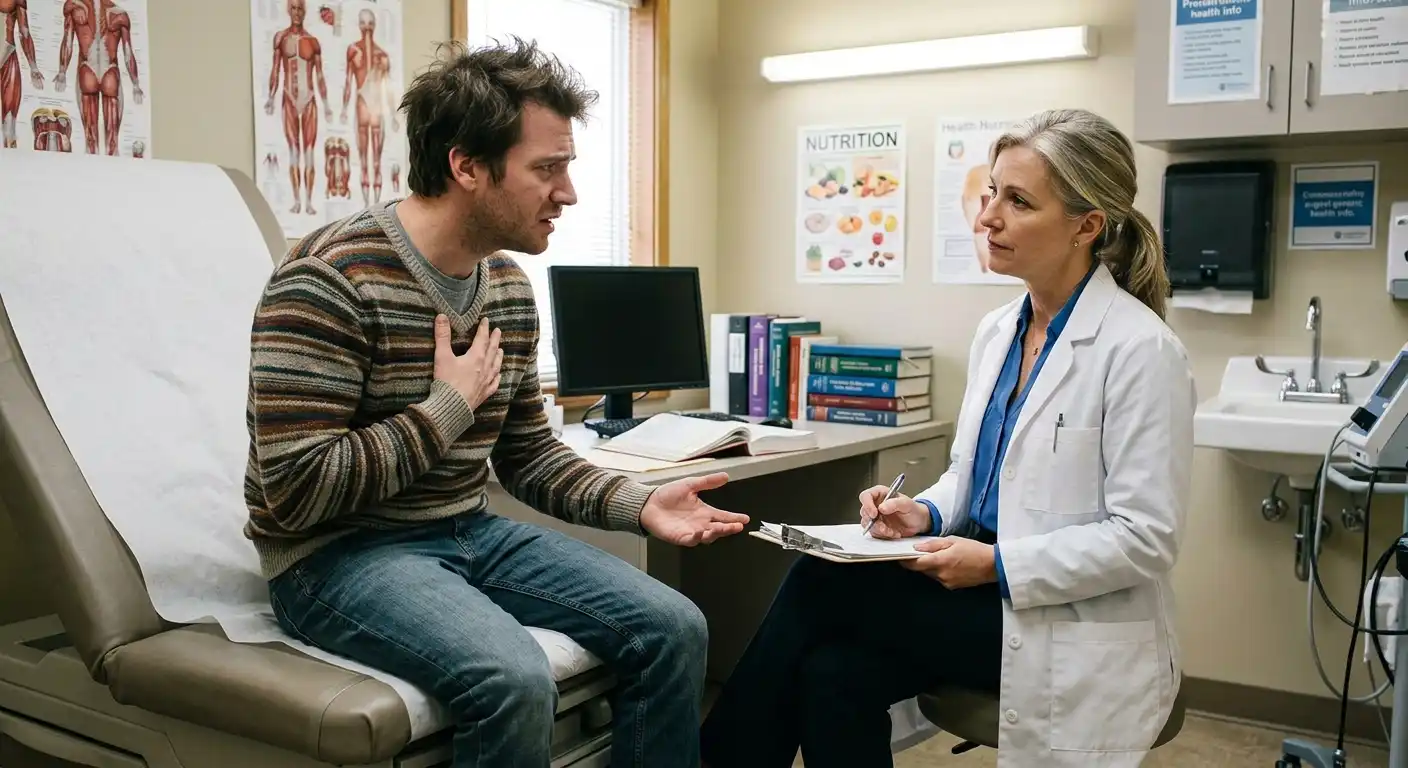
It is 2:47 in the afternoon. You are sitting at your desk and you cannot think straight. Not tired the way you are after a bad night’s sleep – this is different. It is a heaviness you cannot shake no matter how much coffee you drink. You used to push through afternoons like this without thinking twice. Now it happens every day.
You mention it at your annual physical. Your doctor nods, asks a few questions, and tells you the same thing you have heard before: you are getting older, you should try to get more sleep, maybe exercise more, watch the stress levels. No labs. No referral. Just the implication that this is what getting older feels like and you need to accept it.
Here is what nobody told you: that appointment may have failed you.
Low energy is one of the most commonly dismissed symptoms in men’s healthcare – and one of the most frequently misunderstood. There is often a real, measurable reason behind it. And there is often a real path forward.
Why Doctors Miss It
This is not about blaming your doctor. Most general practitioners are genuinely trying to help. But the system they work inside is not set up to catch what is happening to a lot of men in their 40s and 50s.
General practitioners see patients for a wide range of conditions. A man with low energy could have thyroid issues, sleep apnea, depression, vitamin deficiencies, cardiovascular problems, or low testosterone. Working through all of those takes time and specialized knowledge that a fifteen-minute annual physical does not allow for.
And here is the part that matters most: testosterone is often not even tested at a standard physical. It is not part of the default blood panel. If you do not specifically ask for it, it does not get measured. Which means a man can go years – sometimes decades – with low testosterone and never get a diagnosis, because the right question was never asked.
The “normal range” problem
Even when testosterone is tested, there is another issue. Lab results come back with a reference range – the standard for what counts as “normal.” That range is broad. Very broad. The low end of the normal testosterone range for adult men sits around 300 ng/dL. The high end can be 1,000 ng/dL or above.
That means two men can be in the same “normal” range and have testosterone levels that are more than three times apart. A man who was operating at 900 ng/dL in his 30s and has declined to 320 ng/dL is going to feel that drop in a serious way – even though the lab report says normal.
Your doctor sees a result that is technically within range and checks the box. You leave the office feeling exactly the same as when you walked in.
“Just aging” is not a diagnosis
Testosterone naturally declines with age – roughly 1% per year after the age of 30. That is real and that is normal. But there is a significant difference between a gradual decline that is within a healthy range and a drop that is pushing a man into genuine hormone deficiency.
When a doctor says “this is just aging,” they are often making an assumption without the data to back it up. They are not measuring where you were. They are not accounting for your individual baseline. They are comparing a snapshot to a population average and calling it a day.
That is not medicine. That is a guess.
What Low Testosterone Actually Feels Like
Before we get into what to do about this, it is worth naming what low testosterone actually looks like in real life – because it rarely looks like what men expect.
Most men think of low T as a libido problem. And yes, low libido is a symptom. But it is usually not the first or the most disruptive one. The symptoms that tend to show up first are the ones that get dismissed most easily:
- Persistent fatigue that does not improve with sleep
- Brain fog – difficulty concentrating, slower thinking, forgetting things you should not forget
- Irritability and mood changes – shorter fuse, less patience, a flatness that was not there before
- Unexplained weight gain, particularly around the midsection
- Loss of motivation – not depression exactly, but a general loss of drive
- Reduced muscle mass and strength even when you are still working out
- Disrupted sleep – difficulty staying asleep, waking up unrefreshed
What makes this harder is that these symptoms do not announce themselves loudly. They creep in gradually. Your wife notices before you do. Your performance at work quietly slips. You stop doing things you used to enjoy – not because you decided to, but because the energy to do them just is not there.
And because the decline is gradual, most men do what men are conditioned to do: they push through, attribute it to stress or getting older, and wait for it to pass. It usually does not pass. Not on its own.
The symptoms of low testosterone are not dramatic. They are quiet. They erode your quality of life slowly, in ways that are easy to rationalize – until enough time passes that you realize you have not felt like yourself in years.
Why the Standard Advice Doesn’t Work
Sleep more. Exercise more. Reduce stress. Eat better. This is what most men hear, and none of it is wrong as general health advice. But it misses something fundamental.
If your testosterone is clinically low, lifestyle changes are not going to fix it. They can support your overall health. They can help you feel marginally better. But they cannot compensate for a hormone your body is not producing in adequate quantities.
Telling a man with low testosterone to sleep more and exercise is like telling someone with a broken leg to walk it off. The advice is not harmful. It is just not addressing what is actually wrong.
The thing most doctors don’t say out loud:
If you have genuine testosterone deficiency, the only thing that reliably corrects it is testosterone replacement therapy. Sleep hygiene and stress management are good for you regardless. But they are not treatment. They are lifestyle support.
The Dismissal Is Not Your Fault
A lot of men who come to us have internalized the idea that they are somehow complaining about nothing. They went to the doctor, the doctor did not find anything serious, so maybe it really is just aging. Maybe they are being soft about it.
We want to be direct about this: you are not being soft. And the fact that your doctor did not find anything does not mean there is nothing to find. It may mean the right questions were not asked and the right tests were not run.
There is also a cultural element here that is worth acknowledging. Men are not encouraged to talk about fatigue, mood, or loss of drive. There is still a persistent idea that managing through symptoms is somehow more honorable than addressing them. That framing does not serve you and it does not serve the people around you who depend on you.
Low testosterone is a documented medical condition. It has a name, it has measurable markers, and it has effective treatment. Seeking care for it is the same as seeking care for high blood pressure or a thyroid condition. The stigma around it is not based in medicine.
What to Actually Do About It
If any of what you have read here sounds familiar, here is a practical path forward.
Start with the right labs
The first step is getting a clear picture of what is actually happening in your body. This means bloodwork labs – and not just a basic total testosterone number, which is the minimum and often the only thing a general practitioner orders.
At minimum, you need Total Testosterone and a Complete Blood Count (CBC). Total T tells you whether low testosterone is in play. The CBC gives a baseline look at your overall health before any treatment begins. That is enough to have a real clinical conversation – not the complete picture, but a legitimate starting point.
For most men starting TRT, a more complete panel is worth the added clarity. Free Testosterone matters because total T alone does not tell you how much your body is actually using – Free T does. Estradiol (E2) shows how much testosterone is converting to estrogen, which affects how you feel and how your protocol gets dialed in. A Comprehensive Metabolic Panel (CMP) covers kidney and liver function – standard responsible practice any time you are starting an ongoing medication. PSA is a prostate baseline, which is part of doing this right.
If you want the deepest possible baseline – or if you have other symptoms that may point beyond low T – a full panel adds SHBG, DHEA-S, TSH, and a lipid panel. SHBG is what makes Free T numbers truly meaningful: it is the protein that binds testosterone and determines how much is actually bioavailable. TSH and DHEA-S catch thyroid and adrenal issues that frequently show up alongside low T and can affect how you respond to treatment. Lipids give you a cardiovascular baseline that is smart practice for any man over 35.
One thing worth knowing: if you already have labs from a recent physical, bring them. A specialist can often review what you already have and tell you what is worth digging into further – which means you may not need to start from scratch.
Find someone who specializes in testosterone replacement therapy
A general practitioner is not a testosterone specialist. This is not a criticism – it is just the reality of how medical training works. Men’s hormone health is a specialty, and a specialist has seen hundreds of cases that look exactly like yours.
The difference in experience shows. A specialist understands that the normal range on a lab report is not the same as your personal optimal range. They understand that symptoms matter as much as numbers. They know how to read a lab result in context of a real person, not just against a population average.
What you are looking for is not just someone who will prescribe testosterone – any clinic can do that. You are looking for someone who will stay with you through the process: reviewing your labs over time, adjusting your protocol based on how you are actually responding, and checking in when things are not going the way they should.
The prescription is the beginning of the process, not the end of it. Good TRT care means someone is still paying attention six months later.
Know what good care looks like
Not all TRT care is created equal. The online TRT space has grown fast, and with it has come a category of service that is built to get you on a prescription quickly and then mostly leave you alone. You submit a form, you have a short consultation, testosterone arrives at your door, and the relationship ends there.
That model produces mediocre outcomes at best. The starting dose of testosterone is rarely the optimal dose. Getting the protocol right takes time, lab monitoring, and adjustment. A service that does not check in on you cannot adjust what it does not know about.
When you are evaluating options, ask about:
- What does follow-up look like after I start treatment?
- How often will my labs be reviewed?
- Who do I contact if I have questions or something doesn’t feel right?
- How are dose adjustments handled?
If the answer to any of those is vague – “we have a support team” or “you can reach out anytime” without specifics – that is worth noting. Real follow-up means real check-ins at defined intervals, real lab reviews, and real human beings who are accountable to your results.
Ready to get some real answers?
If what you read here sounds familiar, the next step is a conversation – not a commitment. TRTPower offers a free consultation with a real person who has walked through this with hundreds of men. No forms, no pressure, no sales pitch. Just straight talk about what is going on and whether TRT might be right for you.
If it turns out TRT is not the right fit, we will tell you that too.
Talk to us first. It’s free. Click here to get started!
Medical Disclaimer
This article is for educational purposes only and does not constitute medical advice. Testosterone replacement therapy and related treatments require evaluation by qualified healthcare providers. Individual results vary. The symptoms described in this article may be associated with a range of conditions – low testosterone is one possibility among several. Never make treatment decisions based solely on internet content. Always consult licensed medical professionals for diagnosis and treatment recommendations.